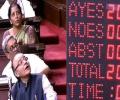
Enthused by the consensus in reaching four-tiered GST tax structure, particularly the unanimity achieved with Congress-ruled states, senior government sources were confident that the Central GST and Integrated GST Bills will be passed by both the Houses.

At present, except Trai, all regulators and the Competition Commission of India (CCI) have powers to levy penalty in case of violation of any rule or law. The GST anti-profiteering authority will be the only institution which will not have the same.

The Budget should use the extra RBI surplus to better effect, suggests A K Bhattacharya.

'If petro products are brought into GST, then there will be minor impact on the incidence of tax... and minor impact on prices. The price of petrol, diesel will continue to be driven by global factors'

'The private sector believes that some enablers in labour-intensive sectors like apparel, toys, tourism, and media retail, can unlock a lot of jobs.'

The challenges before the government, he said, is to put public sector banks back on track and continue to operationalise stalled infrastructure projects

Nasscom president said moving from single to multiple points could be a challenge from the point of view of ease of doing business

GST Council has also reached consensus on the definition of revenue to compensate states for revenue loss

Two sub-committees, set up by the government to resolve the issues of compensation to states for revenue loss on account of a reduction in central sales tax and the final design of GST, are also likely to miss the December 31 deadline.

Any residual amount left in the Compensation Fund after five year compensation period shall be shared equally between the Centre and the states.
The vice president met Leader of the party in Lok Sabha Mallikarjun Kharge, P Chidambaram and Deputy Leader of the party in Rajya Sabha Anand Sharma, among others and discussed various points regarding the key tax reform legislation.

A future road map could be to work towards a single standard rate instead of two standard rates of 12 per cent and 18 per cent, he said.
Arun Jaitley said he would put the DTC Bill in cold storage.

The Goods and Services Tax Bill was passed by the Lok Sabha in May.

"Of the structural reforms, the GST has been the most historic in our country. Its chief architect is not with us today. I pay homage to the visionary leader late Arun Jaitely. GST has been gradually maturing into a tax that has integrated the country economically," she said during her budget speech.

With the total tax burden currently at 53 per cent, 19.5 per cent and 56 per cent, respectively for cigarettes, bidis and smokeless, tobacco taxation in India is much lower than the level recommended by the World Health Organisation.

The IMG meeting will be convened shortly.

The GST Council is scheduled to meet next on November 10 and may consider lowering tax rates on a host of goods such as handmade furniture, plastic products and daily use items like shampoo.

Proposals from the Centre's side include raising the 5 per cent slab to anywhere between 6 and 8 per cent, and doing away with the 12 per cent slab. A few states may oppose such a move because it involves hiking tax on items consumed by the poor. They have instead proposed raising the 18 per cent slab.

Jaitley promised the states that they would be fully compensated for any loss of revenue arising from implementation of GST.

After the 2019 election, one thing is sure: GST will see a number of changes, explains Indivjal Dhasmana.

Finance Minister Pranab Mukherjee will hold a pre-Budget discussion with state governments on January 13.

'Challenge is basically near-term growth as the outlook has turned a bit adverse.'

National Anti-profiteering Authority to be set up for ensuring that customers get the benefit of GST

Top Congress leaders from Karnataka led by Chief Minister Siddaramaiah on Wednesday held a protest in Delhi against the Centre over alleged injustice to the southern state in devolution of taxes, sparking a fierce slugfest between the party and the Modi government.

"At present, there are two main rate slabs under which sa majority of goods are covered -- five per cent and 12.5 per cent -- which will now increase to three (five per cent, 12 per cent and 18 per cent).Will this result in multiple litigations is anybody's guess."

Others taxed at 5, 12, 18, 28%

The Union minister said it is "not fair" on Congress's part to set conditions for the passage of the GST bill and if the said clauses were so crucial, the UPA could have brought these in the original bill when it was in power.

So far, 38.38 lakh taxpayers accounting for 64.42 per cent of the total businesses, who had registered in July, filed returns.
The monsoon session of Parliament is likely to begin in the third week of July and end by mid August.

FinMin does not expect tax or non-tax revenue to reach anywhere close to the targets set in the interim Budget. Sources say that the challenge before the new government will be either to accept the reduced projection and tailor the Budget accordingly or set a more ambitious target.

As many as 30 sub-groups and committees worked tirelessly to devise rules and laws as well as fix tax rates for over 1,200 goods and services.

Common use products like hair oil, soaps and toothpaste will be charged with a single national sales tax or GST of 18 per cent instead of present 22-24 per cent

Companies feel higher rates in India would not be justified.
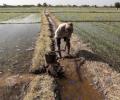
Bharat Krishak Samaj demanded that the Pradhan Mantri Fasal Bima Yojana should be replaced with a new crop insurance and compensation scheme.
He also said that the expert committee on amendments to the Income-Tax Act was expected to submit a draft Bill during the early part of 2006, but did not give any time-frame for the introduction of amendments.
'In a nation where safety standards are the lowest in the world, why make compliance expensive?' asks Aakar Patel.

Although the markets could see a knee-jerk reaction, they rule out a sharp fall.

Assembly elections coming up in November and December could offer a window of opportunity to the government to make GST attractive through rate cuts.
